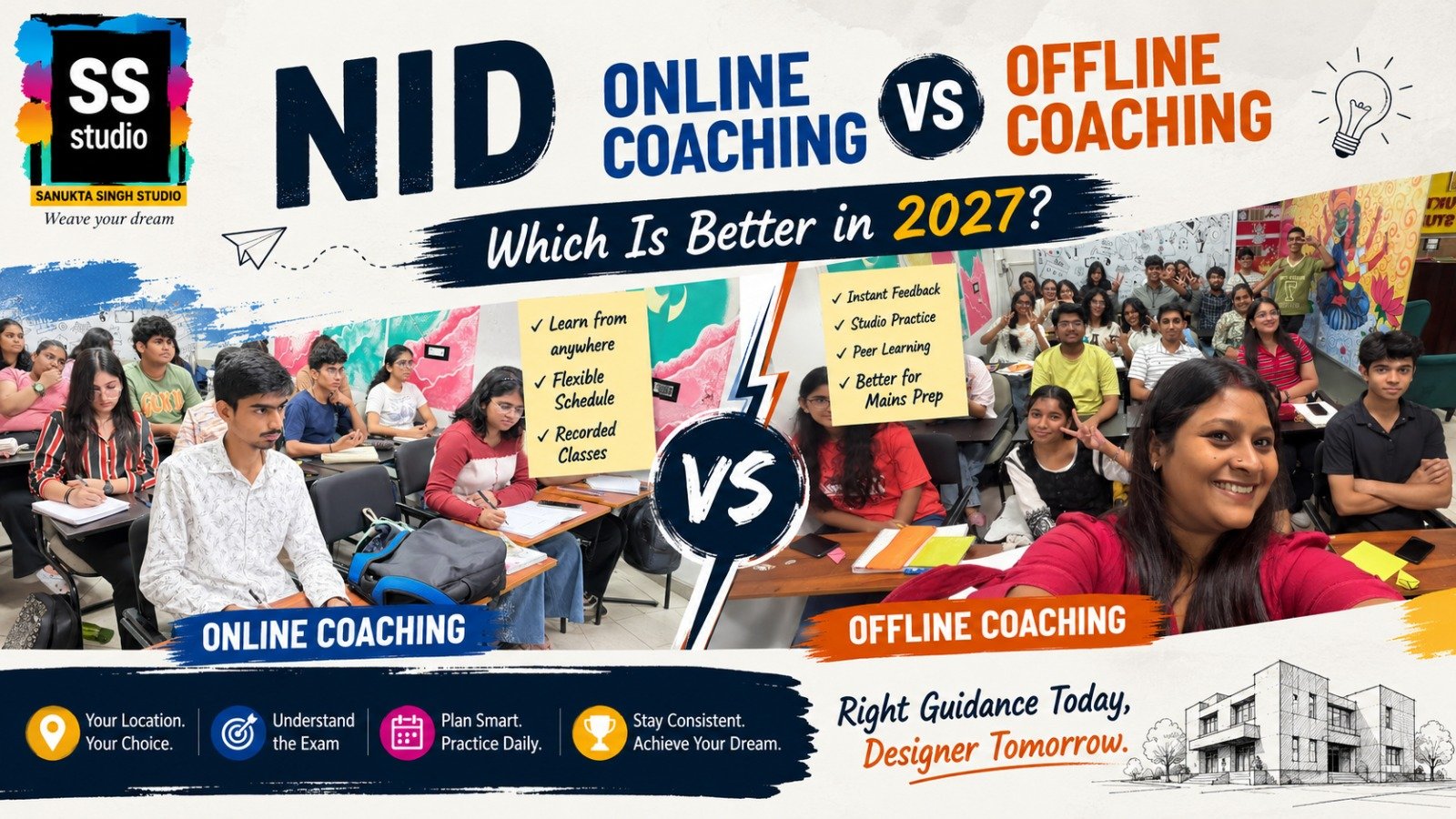
NID Online Coaching vs Offline Which Is Better in 2027?
Every year We hear the same doubt from design aspirants. “Should I go for NID online coaching, or move to a big city and join a proper classroom?” There’s no one-line answer, and anyone who gives you one is probably selling a course.
So here’s what I’ll do instead. We’ll tell you what each option is good at, where it lets you down, and how to pick based on your own situation. This guide to NID online coaching is written for 2027 aspirants, but the logic holds for any year.
A small warning first. We won’t quote fees, batch sizes or results, because they differ from institute to institute and change often. Check each institute’s website and the official NID admission page before you decide anything.
In This Article
- What the exam asks of you, and why that matters
- How NID online coaching works in real life
- What a classroom gives you that a screen can’t
- A comparison table
- Who should pick what, plus a hybrid plan
- Four quick FAQs
Start With the Exam, Not the Coaching
NID takes students into its design programmes through the Design Aptitude Test, called the DAT. It checks how you observe, draw, think visually and solve problems. There’s a Prelims stage first. If you clear it, you move to Mains, which usually has studio work and an interview. The pattern can change, so confirm it on the official website.
Now look at what that means. Prelims is mostly about speed, ideas and logic, and you can practise a lot of that alone. Mains is different. You’ll handle materials, make things with your hands and explain your thinking to a real person. A video call can only do so much there.
Before you compare institutes, be honest about your weakest area. Is it drawing, idea generation, or confidence in front of people? That one answer should steer you more than any advertisement. Let’s see how NID online coaching and classrooms each deal with it.
How NID Online Coaching Works
Most NID online coaching programmes mix live classes, recorded lessons, daily or weekly assignments and doubt sessions. You study from home and upload photos of your sketches. A teacher reviews them and sends comments, either written or as a voice note.
The biggest win is access. If you live in a town with no decent design coaching, NID online coaching puts you in front of experienced mentors you’d never meet otherwise. You also save on rent and daily travel, and recordings mean one missed class doesn’t ruin your week. For a Class 12 student juggling boards, that flexibility is worth a lot.
Now the other side. A photo of a drawing hides things. Your teacher can’t see how hard you pressed the pencil, how your hand moved, or how the paper looked in real light. Feedback can also arrive a day late, by which time you’ve already repeated the same mistake five times.
And then there’s the discipline problem. Nobody will knock on your door if you skip practice. Your phone sits right next to your sketchbook. I’ve seen very talented students fall behind with NID online coaching simply because the routine collapsed in week three.
How Classroom Coaching Works
Compared with NID online coaching, offline coaching is simpler to explain. You sit in a studio, a teacher walks around, and you get corrected while the pencil is still moving. “Your proportion is off here, hold the pencil like this, shade in this direction.” That kind of instant fix is hard to copy online.
You also learn from the people around you. When the student next to you draws a cleaner perspective, you notice it and try harder. For Mains, you get real practice with real materials, which matters.
But classrooms have their own problems. Fees, rent, food and travel pile up, especially if you move cities. Fixed timings clash with school. Big batches can mean a teacher gives you one minute of attention in a whole session. And you’re limited to whoever teaches near you, even if a better mentor exists elsewhere.
NID Online Coaching vs Offline: Side by Side
|
Factor |
Online |
Offline |
|
Cost |
Usually lower overall, check each institute |
Usually higher, with living costs |
|
Flexibility |
High |
Low |
|
Feedback speed |
Depends on the institute |
Immediate |
|
Studio and material practice |
Limited |
Strong |
|
Peer learning |
Through groups and forums |
Natural and daily |
|
Discipline needed |
Very high |
Moderate |
|
Teacher choice |
Wide |
Local only |
|
Mains interview practice |
Mock sessions over video |
In-person mock rounds |
Look closely and you’ll see neither NID online coaching nor classroom training wins every row. That’s the real answer. Which row matters most depends on you.
Who Should Choose NID Online Coaching
Online suits you if you already have decent drawing basics and can stick to a timetable without being chased. It also suits you if you live far from good studios, or if school and boards leave you no room to relocate.
Picture a student in a small town who can’t move for a year. She joins a live NID online coaching batch, blocks two hours every evening and uploads one sketch daily. Her teacher marks it by next morning. It works because she treats it like a real class, with a real deadline.
Set yourself up properly too. You need a quiet corner, steady internet and decent materials. Without those, even good NID online coaching won’t help much.
Who Should Choose Offline Coaching
Go offline if you’re a beginner and your basics, like proportion, shading and line control, need daily correction. If you lose focus at home, a classroom will protect you from yourself. In that situation, NID online coaching can feel too loose.
It’s also the better pick if you live near a good design coaching hub. You skip the relocation cost, and you get hands-on time with models and materials, which you’ll need for Mains anyway.
One honest opinion: if you’re weak at drawing and also easily distracted, don’t start with online. Fix your foundation in a classroom first.
The Hybrid Option Most Students Miss
You don’t have to pick one side forever. Plenty of students begin with NID online coaching for theory, logic and general ability, then add a short offline workshop before the studio round. This keeps your costs lower and fills the hands-on gap. For many families, that mix of NID online coaching and short workshops is cheaper than relocating for a full year.
You can also join an online peer group for weekly sketch challenges. It gives you some of the classroom energy without the travel.
How to Choose in 2027
Don’t pay anyone before you do these things.
- Name your weak area: drawing, ideas, logic or interview.
- Fix a realistic budget, including travel and rent.
- Attend a demo class and watch how feedback is given.
- Ask how fast teachers review work and how many students each one handles.
- Ask exactly how NID online coaching reviews happen, whether by voice note, live correction or written comments.
- Talk to past students, not only the sales team.
- Check the official NID website for the latest exam details.
Be careful with big promises. No coaching, online or offline, can guarantee a seat. Your daily practice decides that.
Here’s a trick I like. Before paying for any NID online coaching programme, take a trial class and send one sketch for review. How the teacher responds tells you almost everything.
So, Which Is Better?
There’s no single winner, and I’d be lying if I said otherwise. NID online coaching works well for self-driven students who lack access to good teachers. Classroom coaching works better for beginners, easily distracted students and anyone who needs studio time.
Still confused? Try NID online coaching for two weeks. If your sketches improve and you stay regular, carry on. If you keep drifting, switch to a classroom without feeling guilty.
Whatever you pick, daily practice beats every other factor. Choose a method, stick with it and keep your sketchbook open. Even the best NID online coaching can’t draw for you.
Frequently Asked Question
Is NID online coaching enough to crack the DAT?
For some students, yes, but nothing is guaranteed. NID online coaching works best when you practise daily, get regular feedback and attempt mock tests. Your effort matters more than the format.
Is offline coaching better than online for NID?
Not always. Offline gives faster feedback and real studio practice, which helps in Mains. Online gives flexibility and a wider choice of teachers. The better one is the one you’ll actually follow.
Can I prepare for NID at home without coaching?
Some students do. You need a clear plan, daily drawing, previous year papers and honest feedback from someone. Coaching mainly adds structure. Check the official website for the syllabus and sample papers.
How much does NID online coaching cost?
It varies a lot by institute, course length and mentor. Check each institute’s website and compare before you pay. Don’t choose on price alone.